
The Short Answer
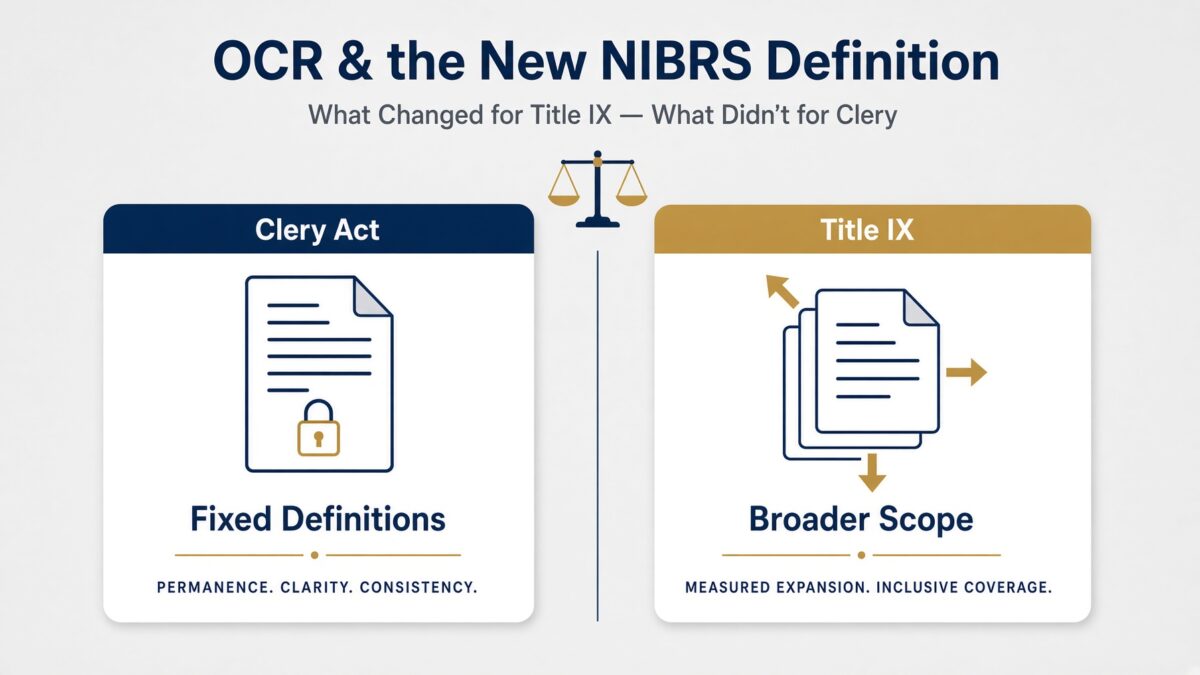
 The recent U.S. Department of Education Office for Civil Rights (OCR) confirmation that it will apply the expanded Uniform Crime Reporting program NIBRS definition under Title IX does not change Clery Act crime statistics or reporting. It may require attention to institutional policy language.
Why Clery Statistics Are Unaffected
- Clery reporting is controlled by the fixed regulatory definitions in Appendix A to 34 CFR Part 668.
- Those definitions can be changed only through formal Department of Education rulemaking.
- The Clery Help Desk has confirmed that NIBRS updates do not alter Clery counting or terminology.
- OCR’s interpretation applies only to Title IX enforcement; it has no authority over the Clery regulations.
What OCR Has Said
- In a July 2026 email, OCR stated that the 2020 Title IX regulations incorporate current NIBRS definitions through the statutory cross-reference (20 U.S.C. § 1092(f)(6)(A)(v)).
- OCR will apply the broader “Criminal Sexual Contact” definition to conduct occurring on or after June 23, 2025.
- This is not formal published guidance, but it is OCR’s clearest statement of its current position.
What the Broader Definition Covers
The NIBRS “Criminal Sexual Contact” definition expands beyond traditional “Fondling” by covering:
- Touching of any clothed or unclothed body parts (not limited to private parts)
- Purposes of sexual degradation or humiliation (in addition to gratification)
- Forced touching by the victim of the respondent’s body parts
Key Principle: Additive, Not Replacement
Any broader Title IX definition sits on top of the Clery Act requirement to prohibit fondling as defined in Appendix A. It does not replace that obligation.
Practical Steps for Institutions
- Leave Clery crime statistics and ASR tables unchanged.
- Review policy and training definitions of sexual assault / nonconsensual sexual contact to ensure they meet the broader scope for Title IX purposes.
- Prefer civil-rights terminology (e.g., “Nonconsensual Sexual Contact”) over criminal language.
- Continue to prohibit the original Clery-defined offenses.
Closing
Clery statistical reporting remains stable. Coordinate with Title IX colleagues on any needed policy updates. The dual-definition situation reflects different drafting choices by two offices within the Department, not a change to the Clery regulations themselves.
This post is for informational purposes only and does not constitute legal advice.
