
The Short Answer
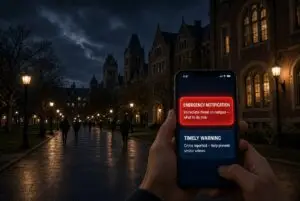 A timely warning and an emergency notification are two different Clery Act duties. One is about a crime that already happened and may happen again. The other is about an emergency happening now on campus.
They often leave on the same text system. That does not make them the same alert. Speed is not the test. The test is which duty you are under.
The text is 34 C.F.R. § 668.46(e) and § 668.46(g), implementing 20 U.S.C. § 1092(f).
Why People Still Mix Them Up
The emergency notification rule was added in 2008. It was never a faster timely warning. Campus communities still expect to hear bad news quickly. That part has not changed.
What has changed is the pipe. Almost every campus now has one multimodal system — text, app, email, web banner, sometimes a loudspeaker. Dispatch uses that stack for both jobs. Policies even tell them to. Using the fast pipe for a timely warning is usually good practice. Calling every fast message an “emergency notification” is not.
If your desk treats the two duties as “urgent alert” and “less urgent alert,” the policy is wrong even if the system is fast.
What Starts Each Duty
Timely warning — § 668.46(e)(1). All three gates must be true:
- A crime listed in paragraph (c)(1) (the Clery catalog);
- Reported to a campus security authority named in your (b)(2) policy, or to local police;
- Considered by the institution to represent a threat to students and employees.
The warning must be timely. It must withhold victim names and other identifying information. It must help people avoid a similar crime. It goes to the campus community.
Emergency notification — § 668.46(g)(1). A different trigger: you confirm a significant emergency or dangerous situation with an immediate threat to health or safety on campus.
That can be a Clery crime. It can also be a gas leak, a tornado, or an outbreak. The catalog is not the test.
The Map Is Not the Same
A timely warning follows paragraph (c)(1). That means Clery statistics geography: campus, noncampus property, and public property next to campus that you can walk onto.
An emergency notification is narrower. (g)(1) and (e)(3) say on campus. A robbery at a recognized off-campus fraternity house can require a warning. It does not, by itself, start emergency-notification procedures.
If your Annual Security Report promises alerts off that map, you have a policy duty. Keep the promise. That is not the regulatory floor.
Who Must Hear It
A criminal threat is often not limited to one building. A timely warning must be reasonably likely to reach the wholecampus community. A burglary series in one hall still goes campus-wide. The next door may be next.
An emergency can be local. (g)(2)(ii) lets you notify only the people at risk. A leak on one lab floor can start with that floor. If the risk grows, the notice grows.
Do not borrow that segmenting rule for a timely warning just because the first blast is a text.
When the Clock Starts
The regulations do not define “timely” by the minute. The point of a warning is to let people protect themselves. Send it when you have enough facts to be useful — even if you do not have every detail.
An emergency notification is immediate once you confirm the emergency ((g)(1)) and without delay ((g)(3)), taking community safety into account.
“Still investigating” is not a timely-warning clock. Neither is an open Title IX file.
The Exceptions Are Not Interchangeable
Each duty has one exception. They are not the same exception.
- Timely warning: no duty if the crime was reported only to a pastoral or professional counselor acting as such ((e)(2)). A Title IX coordinator is not that carve-out.
- Emergency notification: you may wait if sending the notice would, in the judgment of responsible officials, hurt efforts to help a victim or to contain, respond to, or lessen the emergency ((g)(3)).
That hold lives in (g). It does not move into (e). Worry about an investigation may change what the warning says. It is not a reason to hold the warning. Once the institution decides the crime is a threat, (e)(1) requires a report to the campus community.
If the same facts later reach a CSA, or the emergency can be announced without harming the response, the exception ends.
Same System, Two Products
Using the emergency-notification system for a timely warning does not turn the warning into an emergency notification.
Keep the duties separate even when the vendor is the same:
- two procedures;
- two message templates;
- a label on the blast so the file — and the community — can tell which duty you used.
Borrowing emergency-notification shortcuts for a warning is the failure mode: notifying only one hall, sitting on the message under the (g)(3) test, or skipping a noncampus crime because “EN is on campus only.”
When Both Apply
Some facts are both — an active threat on campus that is also a Clery crime, with other people still at risk.
(e)(3) is the hinge, not a mute button:
If there is an immediate threat to health or safety on campus, follow your emergency-notification procedures. If you do that, you do not also have to issue a timely warning for those same circumstances. You must give the community adequate follow-up as needed.
Follow the emergency procedures. Do not send a second product titled “Timely Warning” for those same facts. Do not close the file. “We sent a lockdown text, so we never speak again” is not the rule.
Does a Warning Contain More? What Does Follow-Up Have to Say?
Neither rule hands you a required outline. In practice, the first messages still look different.
A timely warning is about a crime that already happened and may happen again. It usually carries more: what, when, where, what is known about the suspect, how to avoid becoming next, how to report.
An emergency notification is about what to do now — lock down, leave the lab, stay out of that building. The first blast is often a short text because that is what the channel holds and what the moment allows.
Follow-up under (e)(3) is not “send the rest of the timely-warning template later.” The regulation says adequate follow-up as needed.
That means keep people current on the emergency: the threat moved, the building is open, the suspect is in custody. If those same facts were also a Clery crime and people still need information that would help prevent a similar crime, that information is “needed.” Put it in the follow-up. You do not owe a second document with a warning header for those circumstances.
If the first emergency message already named the crime, the place, and the protective step, and the immediate threat is over with no remaining similar-crime risk, an all-clear can be enough. If the suspect is still at large, “we sent a short text” is not enough.
A Working Order
- Confirmed immediate threat to health or safety on campus? Use (g) now. Notify the people at risk. The only hold is (g)(3).
- Those same facts also a (c)(1) crime reported to a CSA or local police and considered a threat? If you already followed emergency-notification procedures on the same circumstances, do not issue a separate timely warning for those facts. Follow up as needed.
- No immediate on-campus emergency? (g) and (e)(3) are off. Work (e)(1): catalog, who received the report, threat. Counselor-only reports stop. Then send a warning that withholds victim identity and helps prevent a similar crime. The text system is allowed. The emergency-notification exception is not.
Write down the decision from the facts you have now. A later attack does not rewrite that moment. A file that never asked the question has not met the standard.
Closing
At SAFE Campuses, LLC, we treat timely warnings and emergency notifications as two tools in one campus safety framework. The phone can be the same. The job cannot. Knowing which duty you are under is how the community gets information in time to use it.
This post is for informational purposes only and does not constitute legal advice.