

The Jeanne Clery Murder of April 5, 1986: The Tragedy That Sparked a Movement
In the spring of 1986, Lehigh University in Bethlehem, Pennsylvania, appeared to be an ideal place for higher education. The small private institution sat on a scenic hillside overlooking the city and promoted itself as a safe, close-knit academic community where students could thrive without worry.
On April 5 of that year, however, that image was shattered when 19-year-old freshman Jeanne Clery was tragically assaulted and murdered in her dormitory room in Stoughton Hall by a fellow student she did not know. The crime sent shock waves through the campus and far beyond, exposing deep flaws in how colleges and universities handled safety information and protected their students.
Who Was Jeanne Clery? Her Life, Family, and Bright Future

Jeanne Clery was a young woman full of energy and promise. Born on November 23, 1966—the day before Thanksgiving—she was the youngest of three children to Howard and Connie Clery and was affectionately called the surprise “turkey baby.” From her earliest years, Jeanne displayed a lively, independent spirit. She was a tomboy who enjoyed playing baseball with the neighborhood boys and earned the playful nickname “Beautiful Bobby” after watching professional wrestling on television. Tennis became one of her great passions; she competed successfully in mother-daughter tournaments at a high level, reaching events connected to the U.S. Open. Those who knew her remembered her as warm, energetic, and deeply connected to her family.
Howard Clery’s own life had prepared him for the resilience the family would later need. In 1945, while playing high-school football in Massachusetts, he contracted polio and became permanently reliant on leg braces and crutches after rehabilitation at Warm Springs, Georgia—the same facility where President Franklin D. Roosevelt received treatment. He graduated from Dartmouth College (Class of 1953) and earned an MBA. He built a successful business career after meeting and marrying Connie—the intelligent, auburn-haired woman he met while working at Gillette. Their partnership had already weathered many challenges, but nothing could have prepared them for the events of April 1986.
The Clery Family Lawsuit Against Lehigh University: Uncovering Hidden Campus Crimes
The loss of Jeanne left the Clerys devastated. In the painful days and weeks that followed, they learned disturbing details about Lehigh University’s approach to campus safety. Security doors that should have remained locked were frequently propped open by students or staff. Campus officials kept internal records of crimes but did not share that information openly with students, parents, or the public. The university had presented itself as a secure environment, yet patterns of unreported incidents suggested a different reality.
In 1987 the Clerys filed a civil lawsuit against Lehigh University, alleging negligence in campus security practices. The legal discovery process revealed extensive evidence. University records showed that 38 violent crimes—including rapes, assaults, and burglaries—had occurred in the three years before Jeanne’s death. None of these incidents had been disclosed to the broader campus community.
The lawsuit drew national media attention and highlighted a widespread problem across American higher education: many institutions treated crime statistics as internal matters rather than information that students and families had a right to know. The case ultimately settled out of court, with Lehigh agreeing to implement significant security improvements. For Howard and Connie Clery, however, financial settlements or facility upgrades were never the main goal. They wanted lasting, systemic change so that no other family would face the same lack of information and preventable risks.
Founding Security On Campus, Inc. in 1987: Turning Grief into Action
That same year, 1987, the Clerys founded Security On Campus, Inc. (SOC), a nonprofit organization dedicated to compelling colleges and universities to release accurate crime statistics and strengthen safety policies. Working initially from their home in Bryn Mawr, Pennsylvania, the organization quickly became a central hub for victims’ families and advocates nationwide. Howard applied the same determination he had shown in overcoming polio to this new mission. Connie became the public voice, speaking with measured strength and clarity about the need for transparency. Their work connected with parents who had lost children, survivors who had endured violence, and policymakers who recognized the scale of the problem.
“Students Or Potential Victims?” The 1988 Clery Security Brochure
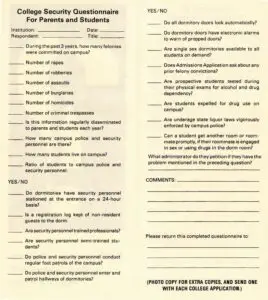 One of the earliest and most effective tools developed by Security On Campus was a brochure titled “Students Or Potential Victims?” widely circulated in 1988 and 1989. This two-sided (front-and-back) publication delivered a straightforward message: students and parents have a fundamental right to honest information about campus safety before making enrollment decisions. It encouraged families to ask direct questions and included a ready-to-photocopy “College Security Questionnaire” designed for use with every college application.
The questionnaire requested specific data covering the previous three years: the exact number of reported felonies, rapes, robberies, aggravated assaults, burglaries, and homicides on campus; whether those statistics were regularly shared with students and parents; the total number of campus police and security officers and the resulting officer-to-student ratio; whether dormitory entrance doors locked automatically; whether alarms activated when doors were propped open; whether security personnel conducted regular foot and vehicle patrols; whether single-sex dormitories were available; whether admissions applications inquired about applicants’ prior felony convictions; and whether drug and alcohol policies were strictly enforced with clear consequences.
The brochure reminded readers that only the institution itself possessed the resources and authority to create and maintain a truly safe learning environment. Thousands of copies were sent to high-school guidance counselors, parents, and prospective students. The simple but powerful tool empowered families to demand accountability and helped shift the national conversation toward openness and prevention.
Pennsylvania’s 1988 Campus Security Law: America’s First State Victory
The Clerys’ advocacy achieved its first legislative victories at the state level. In 1988 Pennsylvania passed the College and University Security Information Act—the first law in the United States requiring both public and private colleges to collect and publish annual crime statistics. Similar measures soon passed in Florida, Tennessee, and several other states. These state laws demonstrated that reform was achievable and created models for federal legislation. They showed that persistent advocacy, backed by real stories and hard data, could overcome institutional resistance.
The 1990 Congressional Hearing: Survivors and Experts Testify on Campus Crime
By 1990 the movement had reached the national stage. On March 14, 1990, the House Subcommittee on Postsecondary Education held a hearing on H.R. 3344, the Crime Awareness and Campus Security Act of 1989. The hearing room in Washington, D.C., filled with parents, survivors, higher-education leaders, and policymakers. Chairman Pat Williams presided, and the bill’s sponsor Representative William F. Goodling opened the session by praising the Clerys’ work and the Pennsylvania law as important models. Representative Mel Levine spoke about the need to amend the Family Educational Rights and Privacy Act (FERPA) so victims of sexual assault could learn the outcomes of disciplinary proceedings.

The Clerys testified, explaining how the absence of timely information had left families unprepared for the realities of campus life. “If you support this bill,” Mrs. Clery said, “you would be saving lives all through the country. It could be someone you love and you know.” They were joined on their panel by other affected individuals, including Dana Getzinger of Safe Campuses Now, who had survived a violent attack at the University of Georgia in 1988 and had become a powerful advocate. Getzinger described discovering similar unreported incidents in her own community after her ordeal. Kristin Eaton-Pollard and Mrs. George Nieswand also offered personal testimonies of loss and the urgent need for change. Frank Carrington, a leading victims’ rights attorney working closely with Security On Campus, Inc., provided expert legal analysis and practical recommendations.
Higher-education representatives presented their views as well. Robert H. Atwell of the American Council on Education discussed the challenges institutions faced and the steps many were already taking to improve safety. Father William J. Byron, president of Catholic University, addressed the balance between academic freedom and security responsibilities. Dorothy Siegel of Towson State University’s Campus Violence Prevention Center shared research showing that victimization was a common part of college life, with alcohol and drug use as significant contributing factors. Douglas Tuttle of the International Association of Campus Law Enforcement Administrators outlined practical measures campuses were implementing and the limitations imposed by existing laws. The full hearing record revealed broad agreement that greater transparency was essential, even as stakeholders debated the best methods of implementation. The testimonies helped build the coalition necessary to move the bill forward.
The Crime Awareness and Campus Security Act of 1990: A Historic First Step
On November 8, 1990, President George H.W. Bush signed the Crime Awareness and Campus Security Act of 1990 into law. For the first time, colleges and universities receiving federal financial aid were required to publish annual security reports containing crime statistics for the preceding three years and to describe their safety policies and procedures. The law marked a historic milestone, but significant gaps remained. Campus police records were often shielded under FERPA interpretations, and there were no uniform national standards for responding to sexual-assault reports or protecting victim rights in disciplinary processes.
The 1991–1992 Fight for the Campus Sexual Assault Victims’ Bill of Rights
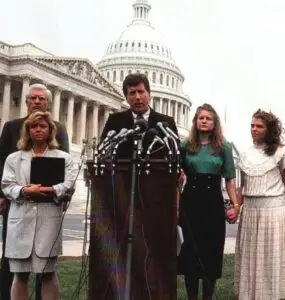 The years 1991 and 1992 brought intensified efforts to close those gaps left by the 1990 Act. The campaign for the Campus Sexual Assault Victims’ Bill of Rights gained powerful momentum in the spring of 1991, as it became evident that the new law provided no specific protections for sexual-assault survivors in campus disciplinary proceedings. The national conversation about acquaintance and date rape on college campuses reached a boiling point that June with Time magazine’s cover story “When Is It Rape?”, which highlighted the experiences of survivors like Katie Koestner and documented how many institutions were subjecting victims to dismissive or re-traumatizing processes.
In response, survivors, student groups, and organizations such as Security On Campus, Inc. and Safe Campuses Now, worked together to advocate for two critical improvements: the Campus Sexual Assault Victims’ Bill of Rights and a clear clarification of FERPA that would treat campus law-enforcement records as public records rather than protected education records.
Representative Jim Ramstad of Minnesota introduced H.R. 2363 to address sexual-assault protections. Correspondence from this period showed growing coordination among advocates. On July 22, 1991, Frank Carrington wrote letters emphasizing the value of a united front in communications with U.S. Secretary of Education Lamar Alexander. A few weeks later, on August 13, 1991, Don Baldwin of the Victims Assistance Legal Organization expressed appreciation for ongoing outreach and confirmed that campus security issues were becoming a priority focus within his organization.
Student-led activities added important momentum. In October 1991, organizers held a National Legislation Rally in Gainesville, Florida, to highlight the pending bills. Ramstad responded to advocacy letters in December 1991, noting that H.R. 2363 had secured 156 bipartisan co-sponsors and that key provisions had been incorporated into the House Education and Labor Committee’s version of the Higher Education Act reauthorization.
July 23, 1992: President Bush Signs Landmark Higher Education Amendments
On July 23, 1992, President George H.W. Bush signed the Higher Education Amendments of 1992 at Northern Virginia Community College. The resulting law required institutions to afford victims of campus sexual assault the same right to legal assistance, or ability to have others present, in any campus disciplinary proceeding that the institution permits to the accused; the right to be notified of the outcome of such proceeding; and the right to immediate relocation to alternative housing or transfer of classes if requested. It also resolved the FERPA ambiguity: records maintained by campus police for law-enforcement purposes were no longer automatically classified as education records and could be released to the public.
That same day, Representative Ramstad issued a press release celebrating the achievement. He quoted Howard and Connie Clery, who stated that the new provisions would help protect women on every college campus in America. S. Daniel Carter, a student advocate, was quoted in the same release: “We believe this legislation is a vital first step in tracking this serious crime which too often has been non-traceable in the student community.”
The Enduring Legacy of the Early Clery Act Era (1986–1992)
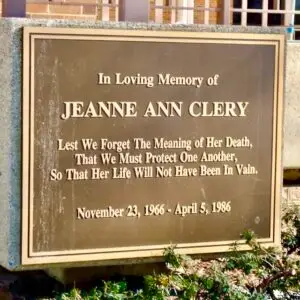 The period from April 5, 1986, to July 23, 1992, represented a profound transformation in how the United States addressed campus safety. What began as one family’s unimaginable loss grew into a sustained national movement for transparency and accountability. The Clerys’ personal journey—from the quiet devastation following their daughter’s death, through the painstaking discovery of hidden campus crime data during their lawsuit, to the founding of Security On Campus, Inc. and the creation of practical tools like the 1988 questionnaire—provided the foundation. Their civil litigation exposed systemic problems, while their nonprofit work connected survivors, parents, and policymakers across the country.
The 1990 Congressional hearing brought those stories into the public record and built the broad coalition needed for the first federal law. The 1992 amendments then strengthened that framework by protecting victim rights and opening law-enforcement records. Parallel tragedies, such as the 1988 stabbing death of Thomas “Tommy” H. Baer at the University of Tennessee, Knoxville, underscored the urgency of the reforms. The original Crime Awareness and Campus Security Act of 1990 and the 1992 amendments together formed the early core of what would later be known as the Jeanne Clery Act. Those laws required honest reporting of crime statistics, clear safety policies, victim protections in sexual-assault cases, and public access to campus police records.
The changes did not eliminate every risk on college campuses, but they fundamentally altered expectations. Colleges could no longer treat crime data as private information, and students gained enforceable rights to know the truth and to be treated fairly after victimization. The story of those six years is ultimately one of ordinary people refusing to accept secrecy and inaction. Parents who had lost children, survivors who rebuilt their lives, attorneys who crafted precise legal language, and countless advocates who organized and testified all contributed. The Clerys’ determination, rooted in love for their daughter and a commitment to preventing similar pain for others, remained the driving force throughout.
Jeanne Clery’s Legacy Lives On: Safer, More Transparent Campuses Today
Their legacy lives on in the safer, more transparent campuses that millions of students experience today. The reforms of 1986–1992 proved that tragedy could spark meaningful change and that persistent, evidence-based advocacy could reshape national policy. Jeanne Clery’s memory, and the efforts of everyone who carried her story forward, continue to protect students across the country.