
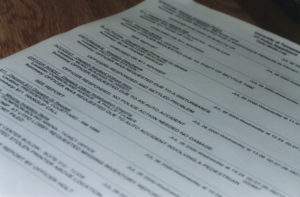
 The public campus crime log is one of the most visible and practical transparency tools within the Jeanne Clery Act. However, it did not appear fully formed in federal law. Over the course of a decade, this vital campus safety measure evolved through grassroots student activism, state-level experimentation, congressional hearings, and negotiated rulemaking.
Its core purpose, as envisioned by the advocates who fought for it, was simple: to give student journalists and campus media timely access to crime information so they could rapidly inform the broader campus community.
Here is the history of how the Clery Act campus crime log requirement came to be.
1991: The Spark at Harvard University
The modern campus crime log movement began with Joshua A. Gerstein, a Harvard Crimson editor and student activist. In 1991, Gerstein drafted legislation in Massachusetts that required college and university police departments to maintain daily public logs of reported crimes and arrests—holding them to the exact same standard as city and town police forces.
As reported in The Harvard Crimson on October 8, 1991:
“The legislation, which was drafted last year by Joshua A. Gerstein ’91, eliminates an ambiguity in the law that allowed college and University police forces to disclose less information in their public logs than city and town police forces.”
Gerstein explained his motivation for the push:
“It had become clear that some colleges weren’t being as forthcoming about reporting crimes on campus. The most sensible thing to do was to make an amendment to the law that would make the same responsibility for campus police to make information public as any other police department in the state.”
Signed in July 1991, this Massachusetts law became the national model for what would eventually become the federal Clery Act crime log requirement.
1989–1995: State-Level Momentum and Safe Campuses Now
Student activists across the country quickly built on Gerstein’s success in Massachusetts.
The grassroots foundation was laid in 1989 when University of Georgia student Dana Getzinger founded Safe Campuses Now (SCN) after surviving a violent attack. In 1991, S. Daniel Carter founded the University of Tennessee, Knoxville chapter of SCN. Under Carter’s leadership, the chapter helped pass Tennessee’s Safe Campuses Reporting Act in 1993, which officially mandated public campus crime logs in the state.
By 1995, Security On Campus, Inc. (S.O.C.)—founded by Howard and Connie Clery following the tragic 1986 murder of their daughter, Jeanne—was actively pushing for a federal version of the open log. The Fall-Winter 1995 issue of S.O.C.’s Campus Watch newsletter noted that Carter was “currently working on federal legislation requiring Open Campus Police Logs at all federally funded colleges and universities.”
1996–1997: Congressional Hearings and Federal Legislation
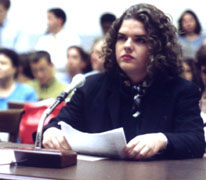
In June 1996, the House Subcommittee on Postsecondary Education held hearings on H.R. 2416, the Open Campus Police Logs Act. S.O.C. submitted extensive materials for the record to promote the crime log requirement.
The legislative push continued into 1997 when the Subcommittee heard testimony on H.R. 715, the Accuracy in Campus Crime Reporting Act, which included the open crime log mandate. Driven by powerful lobbying from the Society of Professional Journalists (SPJ) and the Student Press Law Center (SPLC), advocates argued that annual crime statistics were insufficient for keeping students safe on a daily basis.
Crystal Paulk, testifying for the SPJ and the Campus Courts Task Force, highlighted how open logs successfully protected students at the University of Georgia:
“On a warm spring Sunday morning in 1995, a female student was jogging alone on the sidewalk behind the University of Georgia football stadium… Several hours after the attack was reported, University of Georgia police issued a press release with specific information about the time and location of the assault. It also included a description of the woman’s assailant. This immediate response most likely prevented another assault because the campus community was an informed community.”
Paulk firmly concluded there was “no logical reason” for university officials to deny access to these crucial police reports.
1998: Enactment in the Higher Education Amendments
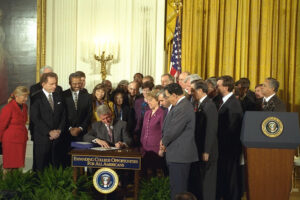
The relentless advocacy paid off. The crime log requirement was officially incorporated into the 1998 Higher Education Amendments (Public Law 105-244), signed into law by President Bill Clinton on October 7, 1998.
The final statutory language (20 U.S.C. § 1092(f)) formally requires institutions with a police or security department to maintain a daily crime log. Crucially, this log must be “open to public inspection” within two business days of the initial crime report.
1999: Final Regulations and Negotiated Rulemaking
Passing the law was only the first step; implementing it required clear federal guidelines. In 1999, the U.S. Department of Education convened a negotiated rulemaking committee to draft the implementing regulations for the Clery Act updates.
The Clery Act Crime Log Today: Empowering Campus Media
While the Clery Act grants public inspection rights to anyone, the advocates who fought for the daily crime log requirement—including Gerstein, Carter, SCN, SPJ, SPLC, and Security On Campus, Inc.—consistently envisioned student journalists as the primary end-users.
Their expectation was that campus media would regularly review the log and act as an information pipeline, disseminating key safety details quickly to students, parents, and faculty. Today, the Clery Act daily crime log is far more than a bureaucratic checkbox; it remains a deliberate, effective transparency tool designed to keep the broader campus community informed and safe.