
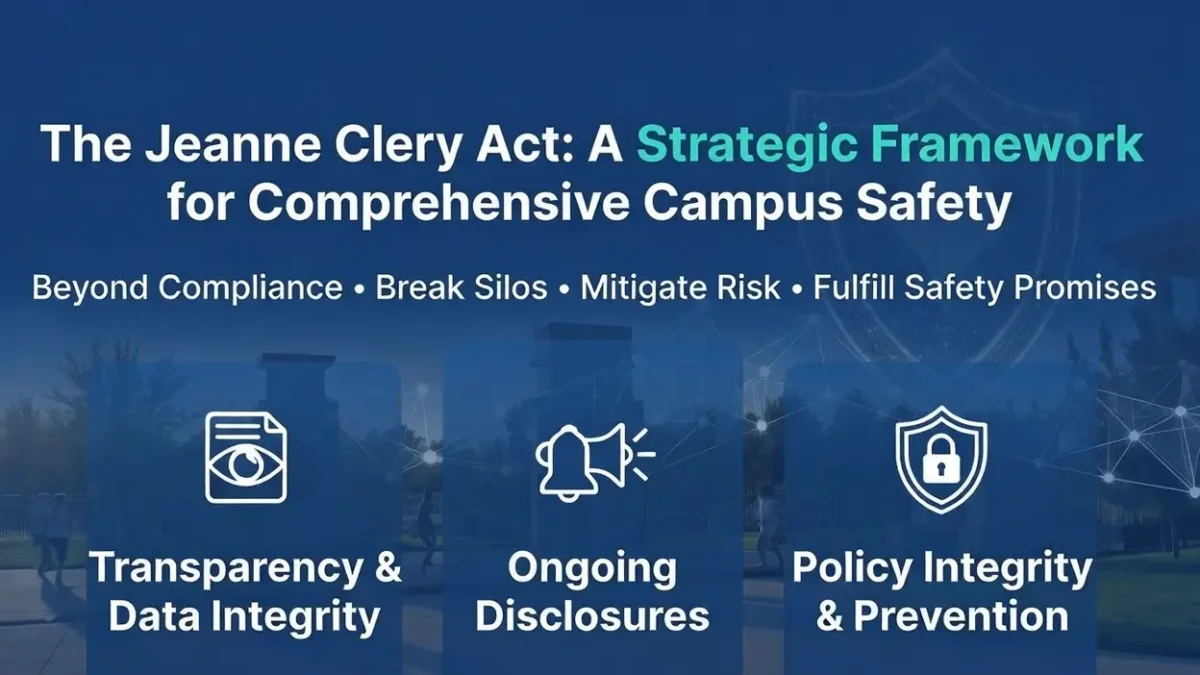

Navigating Jeanne Clery Campus Safety Act compliance in 2026 has never been more critical. With the Stop Campus Hazing Act now in full effect, updated FBI NIBRS definitions, and the U.S. Department of Education able to impose fines of up to $71,545 per violation, accurate reporting, policy drafting, and audit readiness are essential for every Title IV institution.
The 2026 Clery Regulatory Ecosystem
This practical, up-to-date resource brings together the entire Clery Regulatory Ecosystem in one place:
- The statutory foundation (20 U.S.C. § 1092(f), (i), and (j))
- Binding CFR regulations (§ 668.46, § 668.41, § 668.49, and Appendix A)
- Official crime definitions and the current Clery Act Appendix (post-2016 Handbook rescission)
- When-to-use guidance for FBI NIBRS 2025.0, Hate Crime Manual, and related tools
- Clear workflows for the Annual Security Report (ASR), Campus Safety and Security Survey (CSSS), timely warnings, hazing reporting, fire safety, and more
Whether you’re preparing your 2026 ASR, training Campus Security Authorities (CSAs), classifying incidents, or responding to a program review, these concise practitioner guides give you exactly what you need — in the exact order you’ll use them.
Bookmark this page as your first source of information for Clery compliance. All materials reflect the latest 2026 requirements, including the $71,545 civil penalty cap and hazing obligations.
Questions? Email the SAFE Campuses team directly at cleryquestions@safecampuses.biz — we’re here to help.
Start with the Clery Statute section below and follow the recommended workflows for fast, defensible compliance.
Table of Contents
Clery Statute – When to Refer to Each (2026 Practitioner Guide)
These three provisions in 20 U.S.C. § 1092 are the highest-level federal law governing Clery requirements. Refer to them first whenever you need the original statutory authority (before moving to the CFR for implementation details).
- 20 U.S.C. § 1092(f) — Jeanne Clery Campus Safety Act Use for the statutory source of crime statistics, Annual Security Report (ASR) content, timely warnings, emergency notifications, hazing reporting, and the Campus Hazing Transparency Report. Direct link: https://www.law.cornell.edu/uscode/text/20/1092#f
- 20 U.S.C. § 1092(i) — Fire Safety Report & Fire Log Use when your institution has on-campus student housing — for the statutory basis of the Annual Fire Safety Report (AFSR), facility-specific fire statistics, and fire-log requirements. Direct link: https://www.law.cornell.edu/uscode/text/20/1092#i
- 20 U.S.C. § 1092(j) — Missing Student Notification Policy Use for the statutory foundation of missing-student notification procedures and confidential contact registration. Direct link: https://www.law.cornell.edu/uscode/text/20/1092#j
Recommended Workflow 20 U.S.C. § 1092 → “What does the law actually require?” ↓ Then go to the CFR (§ 668.46, § 668.41, § 668.49 + Appendix A) → “How do I implement it?”
Clery Core Regulations – When to Refer to Each (2026 Practitioner Guide)
These four eCFR documents are the binding legal foundation for every ASR, AFSR, and CSSS submission. Refer to them based on the exact task:
- 34 CFR § 668.46 — Your primary regulation. Use first for crime statistics categories, all required ASR policy statements, timely warnings, emergency notifications, daily crime log, CSA/geography definitions, VAWA programs, missing student procedures, and hazing overlay.
- Appendix A to Subpart D of Part 668 — Official crime definitions. Refer here whenever classifying or documenting an incident — this supplies the exact, auditor-required wording for Rape, Fondling, Incest, Statutory Rape, and all other reportable offenses.
- 34 CFR § 668.41 — Distribution and disclosure rules. Use for ASR/AFSR deadlines (October 1), annual notice requirements to students and employees, website posting rules, and how to handle prospective student/employee requests.
- 34 CFR § 668.49 — Fire safety requirements. Use only if your institution has on-campus student housing — for the Annual Fire Safety Report, facility-specific fire statistics, fire log, and fire safety policies.
Recommended Workflow § 668.46 → “What must be in the ASR?” Appendix A → “What are the exact definitions?” § 668.41 → “How do I distribute it?” § 668.49 → “Fire requirements (if applicable)”
Clery Offense Definitions – Practical 2026 Roadmap
Accurate offense classification is the foundation of every Clery compliance decision. The statute and regulations require institutions to report specific crimes using precise, standardized definitions. These four documents form the complete, authoritative toolkit — two are binding law, and two are the most practical references available.
Use them in this exact order:
- 34 CFR § 668.46 Start here. Subsection (c)(1) lists every required offense category you must track (primary crimes, VAWA offenses, hate crimes, arrests/referrals, and hazing via statute).
- Appendix A to Subpart D of Part 668 The binding regulatory definitions (unchanged since 2014). This is the official, auditor-approved wording you must use for Rape, Fondling, Incest, Statutory Rape, and all other core crimes in your ASR and CSSS submission.
- SAFE Campuses “Clery Act Crime Definitions” page Your daily quick-reference tool. Combines the exact text from Appendix A with the current FBI NIBRS 2025.0 and Hate Crime manual definitions in one clean, searchable format — perfect for incident review and CSA training.
- SAFE Campuses “Stop Campus Hazing Act Definitions” page Use exclusively for hazing. Provides the full statutory definition (20 U.S.C. § 1092(f)), student-organization scope, and single-incident compilation rule (hazing is not yet incorporated into the CFR or Appendix A).
- Clery Act Crime Definitions PDF (2026)
Recommended Daily Workflow § 668.46 → “What must I report?” Appendix A → “What is the exact regulatory wording?” SAFE Campuses pages → “Quick lookup, training, and documentation”
Pro Tip: Bookmark or print the four links in this order. Together they cover 100% of Clery crime definitions for the 2026 ASR and CSSS survey. When in doubt, default to Appendix A — it is the document auditors will cite.
VAWA Offenses: Navigating the Statutory Disconnect
The VAWA Reauthorization Act of 2022 introduced expanded definitions for domestic and dating violence, including economic and technological abuse. However, these statutory updates were intended for victim services grant programs, not for the regulatory requirements of the Clery Act.
Per official correspondence from the Department of Education’s Office for Civil Rights (OCR) dated June 10, 2024, institutions of higher education should continue to use the definitions found in 34 CFR § 668.46(a) for both Clery statistical reporting and disciplinary proceedings.
VAWA Definition Roadmap
| Offense | 34 CFR § 668.46(a) Standard (Mandatory for Clery) | VAWA 2022 Statutory Update (DO NOT use for Clery Stats) |
| Domestic Violence | Restricted to crimes of violence committed by a spouse, intimate partner, or cohabitant. | Expanded to include non-violent economic abuse and technological abuse. |
| Dating Violence | Restricted to violence committed by a person in a social relationship of a romantic or intimate nature. | Incorporates broader concepts of economic/technological abuse (exclude from stats). |
| Stalking | A course of conduct causing a reasonable person to fear for safety or suffer substantial emotional distress. | Largely consistent with regulatory standards; focus on the “course of conduct” threshold. |
FBI Uniform Crime Reporting Manuals for Clery – When to Use Each (2026 Practitioner Guide)
34 CFR § 668.46 and Appendix A require institutions to compile statistics using the FBI’s UCR definitions. Because the Department of Education’s regulations are static while FBI manuals are dynamic, practitioners cannot simply “use the latest version.”
The following resources are organized by regulatory weight rather than publication date to ensure 2026 Annual Security Report (ASR) accuracy and audit readiness.
The Practitioner’s Roadmap: Manual Version vs. Offense
| FBI Manual Version | Mandatory Status | When to Use It (The “How”) |
| SRS User Manual (2013) | REQUIRED | Primary Crimes: Use for Murder, Robbery, Aggravated Assault, Burglary, Motor Vehicle Theft, and Arson. These definitions are tied to this manual in Appendix A. |
| NIBRS User Manual (2023.0) | REQUIRED | Specifically for Fondling: Because Appendix A still uses the term “Fondling,” practitioners must refer back to this version for the matching FBI guidance. |
| NIBRS User Manual (2025.0) | REQUIRED | Sex Offenses & Mechanics: Use for Incest, Statutory Rape, and general counting rules (except where terminology conflicts with Appendix A). |
| Hate Crime Guidelines (2022) | REQUIRED | Bias Crimes: Mandatory for applying the “Bias Motivation Test” and defining Larceny-Theft, Simple Assault, Intimidation, and Vandalism. |
Recommended Daily Workflow To maintain a bulletproof audit trail, follow this three-step sequence for every incident classification:
- Check Appendix A: Confirm the regulatory offense name and definition (e.g., “Is this Fondling?”).
- Select the Correct Manual: Utilize the roadmap above to find the version that matches that specific offense.
- Document the Source: In the incident file, explicitly note: “Classified as [Offense] per 34 CFR 668.46, Appendix A, and [Specific FBI Manual Version].”
Pro-Tip: Bookmark the 2013 SRS and 2023 NIBRS manuals specifically. In Clery Act compliance, the Regulation always outranks the FBI’s latest operational update.
Clery Sub-Regulatory Guidance: A Quick History for Practitioners
For decades the U.S. Department of Education issued detailed sub-regulatory guidance (handbooks, Dear Colleague Letters, appendices) to interpret the Clery Act statute (20 U.S.C. § 1092(f)) and its regulations (34 CFR §§ 668.41, 668.46, 668.49 & Appendix A). Although these documents had no force of law, they were often treated as mandatory by auditors and institutions, leading to expansive interpretations, over-reporting, and significant compliance burden.
In 2020, Executive Order 13891 (“Promoting the Rule of Law Through Improved Agency Guidance Documents”) prompted a major deregulatory shift.
The Three Pivotal Documents
- 2016 Handbook for Campus Safety and Security Reporting (265-page document, now labeled “historical purposes only”) This was the comprehensive “bible” used 2016–2020. It added detailed examples, maps, an informal one-mile geography rule, broad CSA lists, and Department-created crime summaries that went well beyond statute and regulation.
- October 9, 2020 Electronic Announcement (updated Jan. 19, 2021) Officially rescinded the 2016 Handbook. The Department acknowledged it had “expanded definitions and imposed requirements beyond the statute and regulations” and stated it would no longer advise institutions to rely on it. However, the announcement explicitly recognizes that many practitioners “may continue to rely upon it for direction” if they elect to do so.
- Clery Act Appendix for the FSA Handbook (13 pages) The current official guidance (still in effect in 2026). Deliberately minimalist, it quotes only the statute and regulations, defers to FBI UCR/NIBRS manuals for definitions, and grants institutions “reasonable interpretation” discretion on geography and CSAs.
Conclusion
 You now have a complete, practitioner-ready roadmap to the entire Clery Regulatory Ecosystem — from statute (20 U.S.C. § 1092) through regulations, definitions, FBI manuals, and daily tools.
Follow the workflows to produce accurate ASRs, AFSRs, hazing reports, and CSSS submissions with confidence.
Reminder: The U.S. Department of Education may impose fines of up to $71,545 per violation.
Questions? Email cleryquestions@safecampuses.biz.
Thank you for the vital work you do to keep campuses safe.
[Compliance Note: Statutory Requirement Pending Regulatory Integration] As of March 2026, the Stop Campus Hazing Act (20 U.S.C. § 1092(f)) is in full effect as federal law. However, the Department of Education has not yet issued updated implementing regulations (34 CFR § 668) or a revised Appendix A to reflect these changes. Practitioners should adhere directly to the definitions and reporting requirements outlined in the text of the Stop Campus Hazing Act until official regulatory guidance is published.
Disclaimer: Educational Resource Only The information provided in this guide is for educational and informational purposes only and does not constitute legal advice or formal regulatory counsel. While this repository is curated to assist Clery Act practitioners in navigating federal requirements, it is not a substitute for official U.S. Department of Education guidance, federal statute, or professional legal counsel. The Clery Act and its implementing regulations are subject to ongoing interpretation, amendment, and audit review. Users are encouraged to consult with their institutional legal counsel or a qualified compliance professional regarding specific applications, reportable incidents, or unique institutional circumstances. Use of this guide does not create an attorney-client or formal consultant-client relationship between SAFE Campuses, LLC and the user.