

 The Jeanne Clery Campus Safety Act (20 U.S.C. § 1092(f)), commonly known as the Clery Act, is the federal law that requires all U.S. colleges and universities participating in Title IV federal student aid programs to annually disclose accurate campus crime statistics and publish comprehensive campus security policies and procedures. What began as a consumer-information law has evolved into a powerful, promise-driven Clery Act compliance framework that delivers transparency, strengthens prevention, and ensures accountability for every student and employee.
Jeanne Clery’s Story
The Act is named in memory of Jeanne Clery, a 19-year-old college freshman who was raped and murdered in her residence hall room on April 5, 1986. Her parents, Connie and Howard Clery, discovered that the university had known about dozens of prior violent crimes on campus but had never shared that information with students or families. Their tireless advocacy led to the first federal campus crime disclosure law.
- Read the full origin story (1986–1992)
- Campus Sexual Assault Victims’ Bill of Rights: History & Impact
- The Origins and Evolution of the Clery Act Campus Crime Log (1991–1999)
- VAWA Amendments to the Clery Act: From Campus SaVE Act to Law
- A Historic Milestone in Campus Safety: Celebrating the Stop Campus Hazing Act
Clery Act Requirements: What Every Institution Must Do in 2026
Every covered institution must meet strict Clery Act requirements to maintain compliance:
- Publish an Annual Security Report (ASR) each year with accurate crime statistics and summaries of campus safety policies.
- Provide ongoing disclosures throughout the year via a public crime log, timely warnings for serious crimes, and emergency notifications.
- Maintain clear policies and procedures for missing residential students and for preventing and responding to dating violence, domestic violence, sexual assault, and stalking (VAWA crimes).
New Stop Campus Hazing Act (2024) requirements added in 2024 also mandate hazing reporting, policies, and prevention programming that must appear in the 2026 ASR.
The ASR must include 16 specific campus security policy statements. These cover everything from crime reporting procedures and security of campus facilities to timely warnings, emergency response and evacuation procedures, alcohol and drug policies, missing student notification, registered sex offender information, hazing prevention, and detailed VAWA policies on prevention, response, victim support, and disciplinary proceedings.
Legislative History
The Clery Act has been strengthened through multiple amendments to meet evolving campus safety challenges, including the Stop Campus Hazing Act (2024) that officially renamed the law the Jeanne Clery Campus Safety Act and added new hazing obligations.
Explore the complete Clery Act Legislative History
Official Name Change to the Jeanne Clery Campus Safety Act
Compliance and Enforcement
The U.S. Department of Education enforces the Clery Act. Violations can result in fines of up to $71,545 per violation, limitation or loss of federal student aid eligibility, and other penalties.
Resources
A Promise-Driven Campus Safety Framework & Clery Act Services
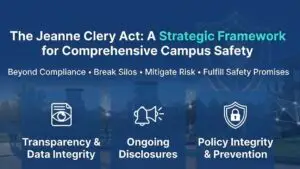 At SAFE Campuses, LLC, we believe the Clery Act is far more than a compliance checkbox. When implemented strategically, it becomes the foundation for a holistic campus safety framework that breaks down organizational silos, strengthens prevention, and fulfills the institution’s promise to every student and employee.
This Clery Act compliance framework rests on three interconnected pillars:
- Transparency & Data Integrity — Accurate, multidisciplinary collection and classification of crime data (now including hazing).
- Ongoing Disclosures — Real-time communication tools that keep the campus community informed and empowered.
- Policy Integrity & Prevention — Formalized, evidence-based policies and education programs that address sexual misconduct, substance abuse, emergency response, and hazing prevention.
Success requires a multidisciplinary Clery Committee that includes stakeholders from Student Affairs, Title IX, Public Safety, Legal, Athletics, and Human Resources. This collaborative approach turns the Annual Security Report into a clear, readable Campus Safety Handbook — a living resource that actually helps students, parents, and employees stay safe.
To help institutions build and maintain this promise-driven Clery Act compliance framework, visit our 2026 Clery Act Compliance Guide — a complete roadmap with step-by-step guidance, updated for all 2026 requirements.
We help institutions move beyond minimum compliance to build a proactive, transparent, and effective campus safety program.
Learn about our full Clery Act Services
Questions about Clery Act compliance? Contact us anytime at cleryquestions@safecampuses.biz.